“Mamma, don’t let your babies grow up to be Cowboys.”
Branding day at the Rattlesnake Ranch kicks off at dawn. Billy Mitchell, a tall man with a neat, well-groomed mustache, feeds, grooms, and saddles the horses with his daughter Serenity’s help. His wife, Julie, prepares food and greets family members—Billy’s ex-wife, her husband, their children, grandchildren, and great-grandchildren—along with friends and neighbors. Most attendees aren’t Cowboys or no longer ranchers, having traveled from afar to support the family. For some, branding day is a way to experience and uphold a historic way of life; for others, it’s a chance to give back.
An underlying cowboy spirit is American, especially tied to the American West, but the lifestyle is becoming harder to maintain. Costs are climbing due to environmental restrictions and limited land. Men and women who have chosen this way of life are trying to hold on, though not always successfully.
Billy Mitchell jokes, “The ranch should be called the ‘Losing Money Ranch,’” because his costs exceed his profits. Most independent ranchers have a second job. Billy’s wife works as a librarian in another town. Billy can no longer afford to hire help. This gathering of part-time buckaroos is a blessing.
Cowboy means different things to different people. To some, it’s about the myth of John Wayne and Roy Rogers – heroes who follow their conscience and make a difference. To environmentalists, the cowboy is a selfish villain draining the land’s resources for their own gain. To others, the cowboy is a rebel, fighting authority, wearing jeans and cowboy boots, and defying rules and regulations.
The Rattlesnake Ranch, located in Johnson Valley, is nestled in the San Bernardino Mountains between Victor Valley and Morongo Basin. Johnson Valley has no post office, no schools, no grocery store, and no central district. The area, once Native American land and currently designated for recreational vehicles and a Marine training ground, has roots in homesteading and mining. The population is approximately 2,000 and mostly elderly.
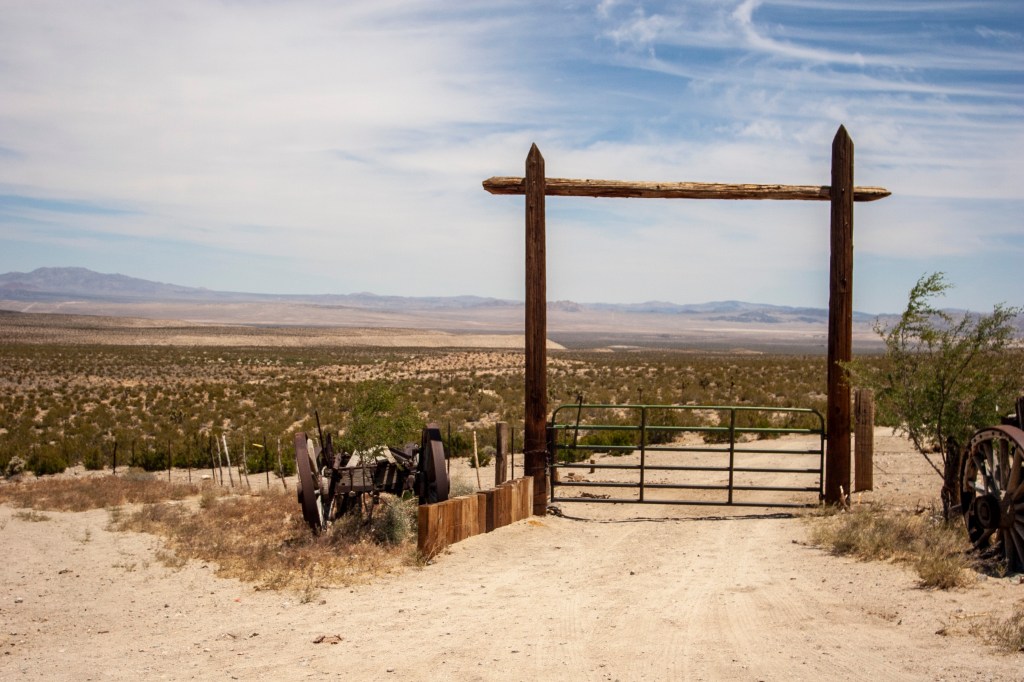
The Ranch, a twenty-minute drive from the main highway, is hidden until you’re approaching the last half mile. When it comes into view after a slow trek along a narrow, rock-strewn dirt road, it takes your breath away. It’s an oasis surrounded by sand and desert plants.
The desert is cold in winter and hot in summer. On a typical June day, temperatures can exceed a hundred degrees, with winds blowing around thirty-five miles an hour. On this branding day, pebbles and sand hit my face because of unseasonably high winds, but the wind provides some relief from the heat.
Rich, a neighbor, fuels the wood-burning stove and prepares irons for branding—three different brands, each representing a different ranch. Some of the ranchers own as few as a dozen animals and graze them on Billy’s land. The cowboys separate the calves during branding.
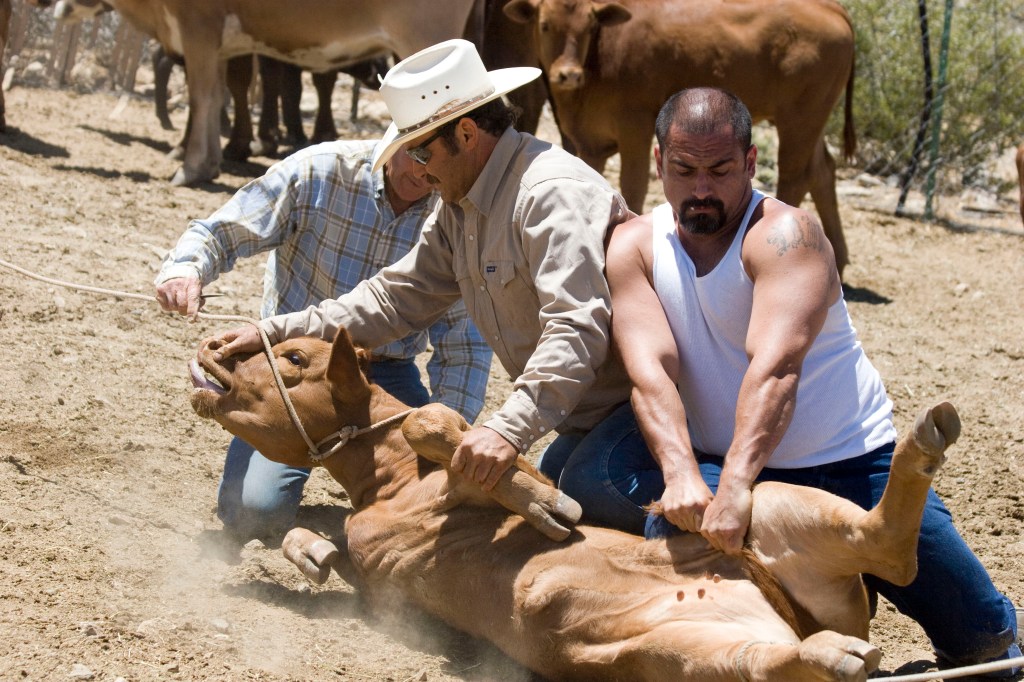
It takes two people to rope an animal, one on horseback, the other standing. Each person, man, or woman lassos the animal until its front and back legs are securely tied, and the animal drops to the ground. Then, an additional three men hold the calf down while Rich applies the hot iron to the animal’s hide. Finally, Serenity and her boyfriend, both age 16, perform the ear notching, and they sometimes castrate the animal.
There is considerable controversy over whether branding harms animals. Billy and the other cowboys disagree. Earmarking, ear tagging, or microchipping are modern methods of branding, but Billy, who aims to keep a connection to the past, believes the old way is the only way.
Billy’s grandfather, his biggest influence, is the reason Billy stays committed to ranching “the way it has always been done,” he said.
Rattlesnake Ranch has some modern conveniences like horse trucks, jeeps, quads, electricity, and an old television. Other essentials are more basic. Water comes from a well; they just got an indoor bathroom, and the family is still building the house.
Three weeks before the semi-annual branding, Billy and his immediate family explored the 29,000 acres of Rattlesnake Canyon and Burns Canyon by quad, jeep, and horseback while looking for cattle. They found the herd 50–60 miles away at the top of BLM land. Many of the roads are dirt and can only be reached on horseback.
Three days before the branding, Billy, his grandson, and a friend pack bedrolls, water, cooking utensils, food, and three horses. They set off for a three-day excursion to round up the cattle and herd them back to the corral.
A small wooden cabin tucked into Burns Canyon, a couple of hours from the Ranch, is an ideal spot for camping. Usually equipped with everything needed for a few days away from home, the cabin, recently vandalized, is now uninhabitable. The door was broken, water pipes were dismantled, and all belongings, including the refrigerator, food supplies, and necessities, had been stolen.
Some off-roaders and bikers vacationing in the area have taken advantage of the hospitality offered. They ignored the signs and fencing erected by Billy and the Bureau of Land Management and entered restricted areas. They cut and rolled up a barbed-wire fence, letting the cattle escape onto the road. One cow, hit by a truck, had to be shot.
The three men lay their bedrolls on the ground before heading out to search for cattle. For this trip, they will sleep outside in the heat, among desert plants and animals. The pipes, which carry water from natural springs to the water troughs, have also been vandalized. Water in barrels is transported on the back of the truck.
When the men find the cattle, they patiently lead them to the corral closest to the house. Herding is a slow process. “Cattle take time to graze,” one of the Cowboys tells me. “If you move too quickly, they lose weight, and you lose money.”
A few calves found away from the herd and needing nourishment are transported back in a truck or quad and fed with an oversized bottle containing a nutritional supplement until they are strong enough to stand on their own.
Ranching is tough work. Due to severe arthritis, Billy can no longer do many physical tasks. When he was younger, Billy worked in rodeo. He saddled broncs, rode bareback, and competed on bulls. He said, “fell a lot, broke a lot of horses and sometimes,” he shrugs, “a horse flips on you.”
There are many ways to get hurt: stampeding cattle, enraged bulls, horses dropping you, falls, rope burns, or, as Billy adds, “you might lose a finger.” In the end, it takes a toll.
Billy, now sixty-four, has worked in construction, ranching, and rodeo—often all at once—and attributes his arthritis to the hard work. “My grandfather always warned me this would happen.” As he says this, he shows me his hands. He tries to open them, but they remain clenched tightly in distorted fists.
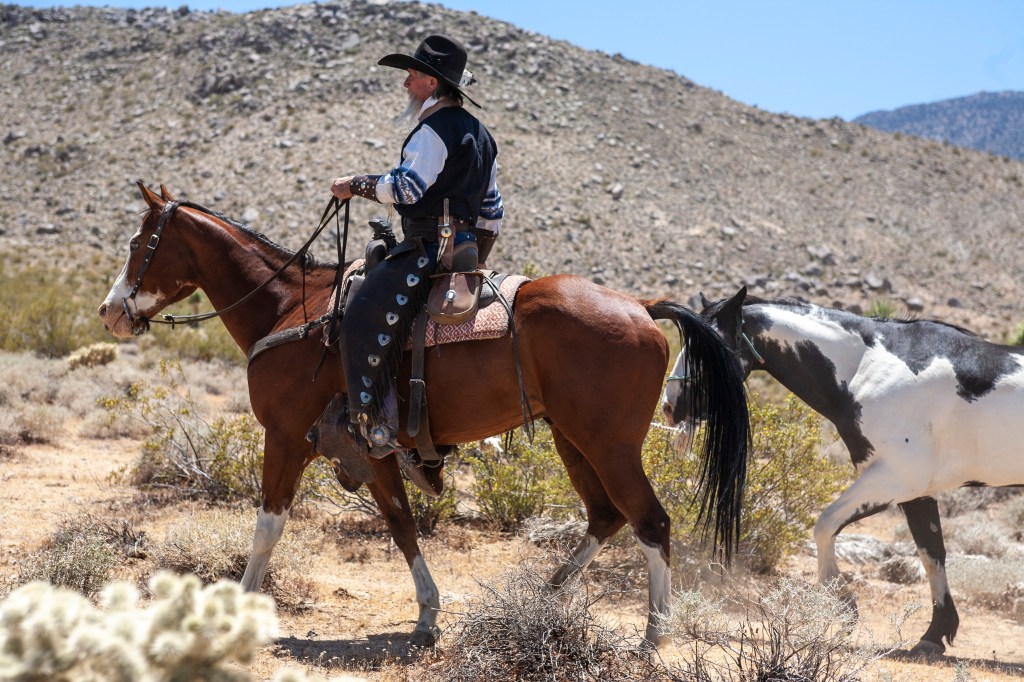
Ranching in the Mohave Desert is especially tough. You’re constantly at the mercy of severe weather. It’s an ongoing struggle to deal with drought, high winds, extreme heat, and cold. Additionally, fluctuating costs and environmental restrictions seem to change with each new political administration.
Most cowboys tell me they are fiercely protective of the environment. Billy works with local environmental groups.
“It is, after all, our livelihood and our home,” Billy said. “The cowboy knows that it does not serve anyone to overuse and overgraze the land.”
Less than a decade ago, Lucerne Valley had sixteen ranching families. Now there are only six. Many ranches have been taken over by environmental groups or sold at a loss. Additional concerns include changes in policies for grazing rights and leases, which are renegotiated every ten years and can be terminated.
Billy has been in Washington, D.C. this year, advocating for ranchers’ rights. He hoped the Ranchers and Environmentalists would collaborate.
“We didn’t have problems with the environmentalists until 1983,” Billy said. He can’t tell me what caused the change.
In 1983, Denzel and Nancy Ferguson called for all cows to be removed from public lands. Their book, Sacred Cows at the Public Trough, became widely read. Billy doesn’t know the book, but the anti-ranching sentiment sharply appears after Sacred Cows is published.
Current lawmakers on both sides of the political fence are working hard to find equitable answers, but the issues, for now, persist.
On branding day, everyone has a role. The women cook, the children ride, round up, rope, or feed the strays. Despite how tough this life is, no one I talk to complains. When I ask them, “Do you have any regrets?” They all pause and think about it. They look around at the wide-open space and the unexpected beauty of the desert, then say, “My life is blessed.”
With the branding finished, everyone gathers around the house. Homegrown beef is cooked on the grill. Someone made salsa, guacamole, rice, and beans. The Cowboys bring beer and a bottle of whiskey. Billy says a prayer, thanking God for the cattle, his family, friends, the land, and the animals.
 Hilary Sloane- Journalist and Photographer